Light Burned Magnesia in Magnesium Cement Board
- Share
- publisher
- HOLY Magnesium Industry
- Issue Time
- Oct 28,2026
Summary
How reactive light burned magnesia drives MgO board strength, set time and water resistance.
Light Burned Magnesia in Magnesium Cement Board
Magnesium cement board, widely sold as MgO board, magnesium oxide board or glass-magnesium board, has become a mainstream construction panel for fire-rated walls, sheathing, subfloors, ceilings and prefabricated modules. Its binder is not Portland cement but a magnesium oxychloride or magnesium oxysulphate cement formed by reacting reactive light burned magnesia with a magnesium salt solution. Because the magnesia is an active chemical reactant rather than an inert filler, the quality of that magnesia determines most of the board's engineering properties.
The Chemistry Behind the Board
In the magnesium oxychloride system, often called Sorel cement, reactive magnesium oxide is mixed with an aqueous magnesium chloride solution. The MgO hydrates and reacts to form crystalline oxychloride phases that interlock and develop strength. The magnesium oxysulphate system substitutes magnesium sulphate and produces different crystalline phases with lower chloride content, which is preferred where chloride leaching or corrosion of embedded metal is a concern. In both systems the MgO must be genuinely reactive: dead burned or heavily sintered magnesia will not form the binder phases at a useful rate.
Reactivity and Activity Index
Reactivity is the first specification a board producer should control, because it drives set time and early strength. Overly reactive magnesia sets too fast, generates excessive heat, and can cause cracking and distortion in thick panels; under-reactive magnesia gives a slow set, low early strength and long demoulding times. Producers typically characterise reactivity with a citric acid neutralisation test or an iodine activity number, and then hold the incoming material inside a defined activity band. Calcination temperature is the lever: light burned magnesia is produced at roughly 700 to 1000 C, and small changes in that window produce large changes in activity.
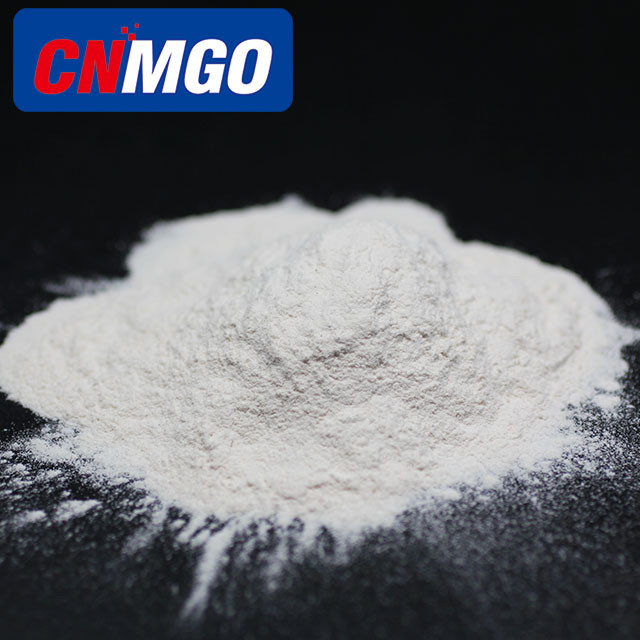
Industrial grade CCM powder, MgO 85 to 92 percent, the standard board binder grade.
Mix Design and the MgO to MgCl2 Ratio
Board formulation is a balancing exercise. The molar ratio of MgO to MgCl2 and the water to solids ratio determine which oxychloride phases form, and different phases have very different water resistance. An unbalanced mix leaves unreacted magnesium chloride in the board, and that free chloride is hygroscopic: it absorbs atmospheric moisture and migrates to the surface, producing the sweating or weeping failures that have damaged the reputation of poorly made MgO board. Correct stoichiometry, adequate curing, and the use of modifiers such as phosphates or fly ash substantially reduce this risk.
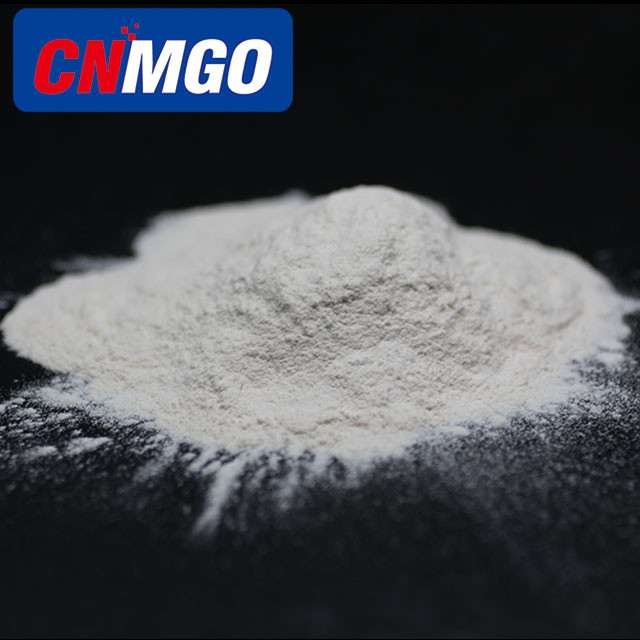
High purity CCM powder for producers targeting consistent premium board grades.
Fillers, Reinforcement and Curing
A typical board formulation combines reactive magnesia and salt solution with fillers such as fly ash, silica fume or calcium carbonate, plus perlite or wood fibre for density and workability, and glass fibre mesh for flexural strength and impact resistance. Curing conditions matter as much as formulation: boards need controlled temperature and humidity to complete the reaction and to stabilise dimensions. Producers should cure, then condition to equilibrium moisture before shipping, since panels shipped wet will continue to move and can warp on site.
Quality Control on the Board Line
Practical incoming checks on magnesia include MgO content, loss on ignition, fineness, and an activity measurement, all tracked by lot so that the mix can be adjusted when activity drifts rather than after a batch has failed. Finished board should then be verified against the relevant standard for flexural strength, impact resistance, fire performance, water absorption and dimensional stability. Consistent, documented magnesia is the cheapest insurance available to a board producer, because it removes the largest single source of batch-to-batch variation in the process.
Troubleshooting Common Board Defects
Most board failures trace back to a small number of root causes. Surface sweating or weeping indicates excess unreacted magnesium chloride, and the fix is corrected stoichiometry, better mixing and more complete curing. Cracking and warping usually point to excessively reactive magnesia combined with high exothermic heat and rapid drying, so slow the set with a controlled activity band and improve curing humidity. Low flexural strength typically means under-reactive magnesia, insufficient compaction or poor fibre distribution. Efflorescence and salt bloom are symptoms of soluble salt migration, addressed through mix balance and curing. Chalky or soft surfaces suggest carbonation from prolonged exposure to air during storage. Linking each symptom back to a controllable input is faster than changing several variables at once.
HOLY Perspective
HOLY (CNMGO Group Limited) supplies light burned magnesia and caustic calcined magnesite from Dashiqiao in Liaoning to construction material producers in more than 50 countries. Share your target activity band and MgO specification and we will match a grade with lot-to-lot consistency.