DBM Bulk Density and Slag Corrosion Resistance
- Share
- publisher
- HOLY Magnesium Industry
- Issue Time
- Oct 7,2026
Summary
Bulk density predicts DBM slag resistance: target values, sintering effects and specification.
DBM Bulk Density and Slag Corrosion Resistance
Ask two refractory engineers what single number best predicts how dead burned magnesia will behave in contact with steel slag and you will get two answers: chemistry and bulk density. Chemistry sets the thermodynamic limit, but bulk density is the practical proxy for how well the raw material was sintered and how easily molten slag will penetrate it. Understanding the link lets a buyer write a specification that actually correlates with campaign life instead of one that simply looks rigorous.
What Bulk Density Actually Measures
Bulk density is the mass of a unit volume of granular or shaped material, including pore volume, usually reported in grams per cubic centimetre. For dead burned magnesia it reflects the degree of densification achieved in the shaft or rotary kiln. Well-sintered refractory DBM commonly falls in the range of 3.20 to 3.45 g/cm3 for grain, with apparent porosity often below 5 percent for the dense grades. Because pure periclase has a true density near 3.58 g/cm3, a bulk density of 3.40 implies very low open porosity, while a value of 3.10 implies a material with substantial accessible pore space.
The Mechanism: Penetration Before Dissolution
Slag attacks magnesia in two stages, and the first stage is the one bulk density controls. Molten slag first infiltrates open porosity by capillary action, then dissolves the periclase grains it contacts. Low-density, high-porosity DBM offers a large internal surface area and wide pore channels, so slag travels deep into the structure and attacks from within, producing a thick, weakened reaction zone that spalls away. Dense, low-porosity DBM limits infiltration to a thin surface layer, so the reaction zone stays shallow and the lining retains its mechanical integrity. This is why two grades with identical MgO content can show dramatically different corrosion rates.
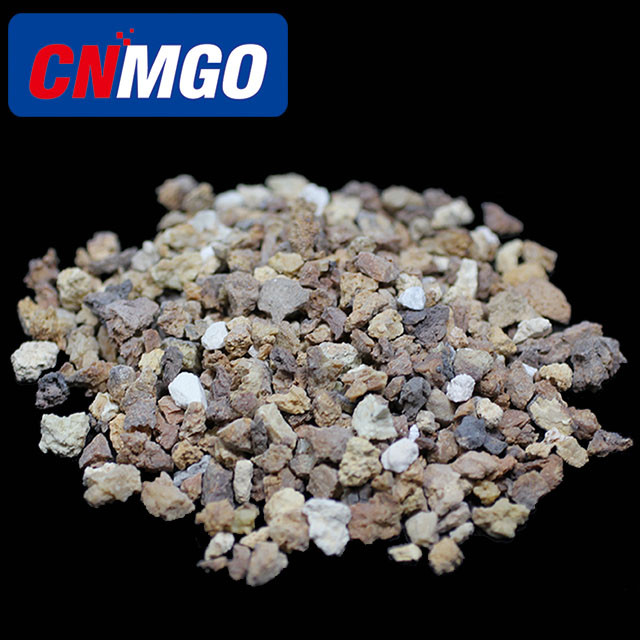
Sized DBM lump fractions used as dense refractory aggregate.
How Sintering Temperature and Time Drive Density
Density is created in the kiln. Dead burned magnesia is produced by calcining magnesite above roughly 1500 C, where periclase grains grow and pores close. Higher temperature and longer residence produce larger crystals and higher density, but also lower the reactivity of the product, which is why DBM is deliberately made relatively inert compared with caustic calcined magnesite. Insufficient burning leaves residual porosity and higher loss on ignition; overburning wastes energy. A consistent kiln operation is what produces a consistent density band from lot to lot.
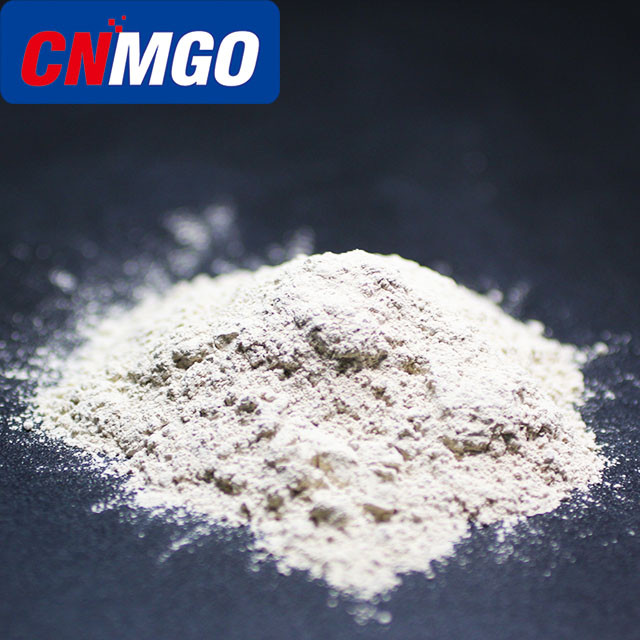
DBM powder at 325 mesh, the reactive fine fraction in refractory formulations.
Reading Density Together With Chemistry
Density alone is not enough. The CaO to SiO2 ratio determines which silicate phases sit at the grain boundaries, and those phases control high-temperature strength. A dense DBM with a poor CaO to SiO2 ratio can still fail because a low-melting boundary phase forms above 1500 C. The practical specification therefore combines four items: MgO content, CaO to SiO2 ratio, bulk density and grain size distribution. B2O3 also deserves attention, because small amounts of boron dramatically lower the melting point of the silicate bond phase and are a known cause of unexpected high-temperature softening.
Testing and Verifying Density on Receipt
Bulk density can be checked quickly with a calibrated pycnometer or by the standard mercury or water displacement method on representative grain samples, and apparent porosity follows from the same measurements. The critical discipline is sampling: take increments from multiple points in the lot, composite them, and test the composite rather than a single scoop. Agree the method with your supplier before shipment so that your result and theirs are comparable. Where the campaign is critical, confirm bulk density on each lot and track it over time, because a drift in density is an early warning of a kiln change.
Practical Density Targets by Position
Density requirements are not uniform across a plant. Slag line bricks and other positions in direct, continuous contact with fluid slag justify the densest available grain, typically above 3.35 g/cm3, because penetration resistance is the dominant requirement. Backup linings and safety linings, which see lower temperature and little slag contact, can use a lower-density, lower-cost grade without measurable loss of campaign life. Monolithic and gunning mixes need a combination: dense aggregate for penetration resistance plus a reactive fine fraction that sinters in place to bond the structure. Ramming mixes behave similarly, and the fines content should be tuned so the mix densifies under vibration without generating excess shrinkage cracks. Specifying position by position is how refractory buyers convert a density number into actual cost per tonne of steel.
HOLY Perspective
HOLY (CNMGO Group Limited) produces dead burned magnesia at Dashiqiao in Liaoning with controlled sintering to hold bulk density within a tight band lot after lot. For refractory buyers we recommend specifying MgO, CaO to SiO2 ratio, bulk density and grain fractions together, and verifying density on receipt.